Category Archives: science

Resonating Resonances!

RRRrrrrrssssssssssnnnnnncccccccceeee.

I’m sorry, I was doing an impression of a resonating object there, mainly because I feel that starting with a description of what resonance is would be pointless. Everyone knows what “to resonate” means, and as far as physical principles goes all schoolchildren get taught about Galileo Galilei and oscillating pendulums when they’re doing their GCSEs. Basically if you have something undergoing a persistent, periodic motion, then it will transfer and store energy with more efficiency at certain specific frequencies resulting in a greater amplitude of motion. Most people understand this in the context of pendulums, as above – where, if you release a pendulum and let it settle for a few seconds, it will eventually swing with a period 

where l is the length of the pendulum and g is the pendulum’s acceleration due to gravity.

Continue reading →

Tagged , , ,

This Is Why Galactus Likes Eating Planets.


Tectonics. Tectonics. It’s a word that you can really roll around in your mouth, like a tic-tac. Or a tim-tam. Or a tick-tock. Okay, maybe not that last one. Tec-ton-ics. Aside from its phonophiliac qualities the study of plate tectonics and the Earth’s interior is very interesting from a planetary science point of view, because the Earth has some internal qualities that are – as far as we know – unique amongst the discovered planets.

Continue reading →

Tagged , , , ,

Atmospheres, How Do They Work?


Terraforming’s a bit of a thorny debate these days. Even leaving aside the question of whether or not we should be doing it in the first place — I once gave a talk where I referred to people who thought we should preserve the Martian surface as a sort of natural park as “crazy lunatics1”, only to have one of the other speakers come up to me afterwards and tell me he was one of them2 – there are many technological hurdles to be overcome, ranging all the way from raising/lowering the temperature of an entire planet to a liveable standard to generating a breathable atmosphere. While some of these hurdles are truly significant and will require decades – or even centuries – of technological advance before we can terraform a planet in any meaningful way, there’s also a lot of wilful obfuscation going on about just what is and isn’t possible in the first place. For example, some people will tell you that there’s no point in colonising and terraforming Mars because it’s too small to effectively retain an atmosphere. You should not trust these people, because they are lying – or at least, they are being very economical with the truth.

Continue reading →

Tagged , , , , ,

Nukes: The Swiss Army Knife Of Hollywood.

 This post stems from a conversation I was having with Josh about the possibility of colonising Mars. I was saying how the major stumbling block would be finding a solution to the solar radiation problem since Mars is geologically dead. We’re protected from all the harmful stuff on Earth by the magnetosphere, which is generated by a spinning liquid iron core that basically acts as a giant electromagnet, but Mars’ internal dynamo – if it ever had one – ceased activity a long time ago. Josh then asked the following question:

“Could we restart it?”

Ahahaha. Ahahahahaha. Ahaha. No.

Continue reading →

Tagged , , , ,

The Fermi Paradox And Other Aquatic Mammals.

 I apologise in advance if this post doesn’t contain much science. As we’ve seen astronomy is mostly based around an astounding amount of ingenuity and bloody-mindedness backed up by not a small quantity of guesswork, but when it comes to dealing with questions like the Fermi Paradox we don’t even have enough information to make an educated guess. As a result things can start to get a little metaphysical, almost bordering on sci-fi at times.

Continue reading →

Tagged , , , , ,

That’s My Favourite Kind Of Planet.

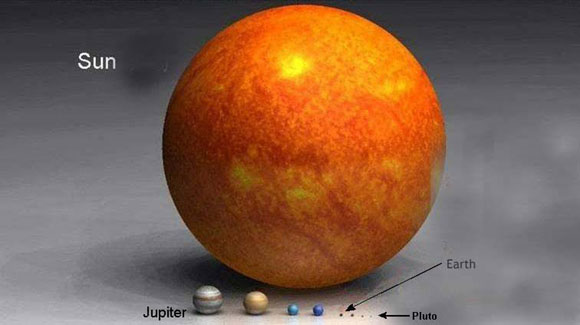
Here’s an interesting fact: if you smooshed together everything in the Solar System that was not a star — all the planets, moons, asteroids and other assorted junk out there — you would end up with a ball of stuff with just one seven-hundredth the mass of the Sun. The Sun has 99.86% of the overall mass of the Solar System.

Here’s another interesting fact: if you took a pea and put it next to a basketball, you would achieve roughly the same visual effect as if you took the largest planet, Jupiter, and put it next to the Sun.

Continue reading →

Tagged , , , ,

Love Don’t Live Here Anymore.

The K.B. stands for Kuiper Belt. SCIENTIST HUMOUR.

I picked up a compendium of H.P. Lovecraft’s short stories a couple of weeks ago – mainly so that I could amuse myself by playing Lovecraft Bingo (counting how many times he uses words like ‘accursed’, ‘pnakotic’ and ‘squamous’ ) – and ended up being rather amused when I came across the story “The Whisperer in Darkness”. This consists of about sixty pages of the usual confused rambling while the reader waits for him to get to the damn point already, but ultimately turns out to be about advanced aliens from Pluto who have set up a mining colony in the furthest reaches of the American hills that they’re trying to keep secret. This brought a wry smile to my lips for two reasons:

  1. Lovecraft’s shameless attempt to piggyback off of something that was very much part of the public zeitgeist at the time, what with him starting this story the same month that Pluto was discovered. It’s the literary equivalent of somebody sticking dark matter into their awful sci-fi novel because they think it sounds exotic and dangerous.
  2.  That there was ever a time when people thought Pluto was an important place that might support life of any kind.

 The whole Pluto “controversy” a few years ago stems from a variety of roots: a bureaucracy which ran a sloppy vote, scientists with vested interests and pet theories on both sides of the argument, and —  bizarrely – a great deal of public sentiment for what is essentially a lump of ice and rock out in the middle of nowhere. If you want to trace it back to the beginning, though, you have to start with the discovery of Pluto in 1930. Are you sitting comfortably? Time to Listen with Mother.

Continue reading →

Tagged , , , , ,