
In which I tackle one of the things that for a long time seemed like a colossal fudge to me, but which has an ever-increasing weight of evidence supporting it: inflation theory.

In which I tackle one of the things that for a long time seemed like a colossal fudge to me, but which has an ever-increasing weight of evidence supporting it: inflation theory.

I’ve had two quite profound demonstrations this week of how a simple difficulty setting can drastically change your perception of a game. My first was with Fire Emblem; after recalling just how much time I spent raging against the GBA incarnations whenever I lost a character I decided to save myself a lot of bother by turning permadeath off, but this removal of all risk from the equation turned most of the campaign – and especially the end of it – into a braindead steamroller. Fire Emblem just isn’t meant to be played that way, and I gained a new appreciation for just how fundamental that feature is the overall feel and flow of the game. Max Payne 3 has given me the complete opposite experience, however. I dialled the difficulty up to Hard because that tends to be the only way I can get challenge out of these interactive shooting galleries these days, only to have this throw many of the game’s shortcomings into sharp relief. With a more accommodating difficulty setting I probably wouldn’t have noticed; giving me more latitude to make mistakes means the game has more latitude to make mistakes, and I would have breezed through the entire thing and ended up assessing the combat system as “functional” when in fact it’s actually one of the most poorly-designed shooters I’ve ever seen.
The perfect music to browse and buy 13 different variants of AK-47 by.

Yes, it’s one of those periodic posts where I make excuses for the distinct lack of posting recently. There have been things getting in the way the last couple of weeks and I’m having trouble finding enough times to both play games and write about them, or do the background research necessary for science posts. This is nothing new; I write this blog because it’s a genuinely healthy thing for me to do and the trickle of posts will never dry up completely, but this state of affairs looks like it is going to continue and I just wanted to save anyone still reading it some time by outlining when exactly they should be checking for new posts (if they don’t have reader programs that do it automagically, that is.)
Tl;dr version: checking back every Monday is probably the most efficient way to read this blog for the time being, so really it’s business as usual since I started my new job. Life catches up with us all, I guess.

Two years before the outbreak of World War Two the Japanese introduced a new high-level diplomatic cypher that the US named Purple. Purple was a cutting-edge cryptosystem that proved fiendishly difficult to break, using machine-generated cyphertext with a similar level of complexity to the Enigma devices — but unlike Enigma the US were unable to capture any working Purple devices to give them clues as to the design of the system. All they had to go on was underlying patterns in the cyphertext and the cribs (or operational errors) that represented the few chinks in Purple’s armour. Nevertheless, by 1941 the SIS had constructed an analogous device that successfully decoded Purple messages based on just this information, in effect making a perfect working replica of the Purple device without ever having seen one themselves.
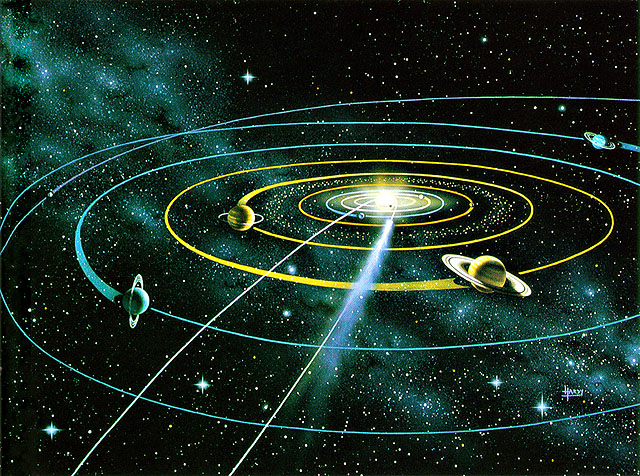
After last week’s dark matter post in which I mentioned that the outer planets are orbiting more slowly than the inner ones due to Kepler’s third law, Jim commented
In my head Neptune was going super-fast but over a gigantic distance which explained the longer time.
BIG MISTAKE.

The best thing about MechWarrior Online is the startup routine your pilot goes through every time they enter a match. When it begins you’re treated to a first-person view of the cockpit interior of your unpowered mech, with no HUD or other visual accoutrements apart from a pair of hands pushing buttons, flipping switches and even test-waggling the control stick while a calm, computerised voice intones the following:
“Reactor: Online. Sensors: Online. Weapons: Online.”
“All systems nominal.”